Table Of Content
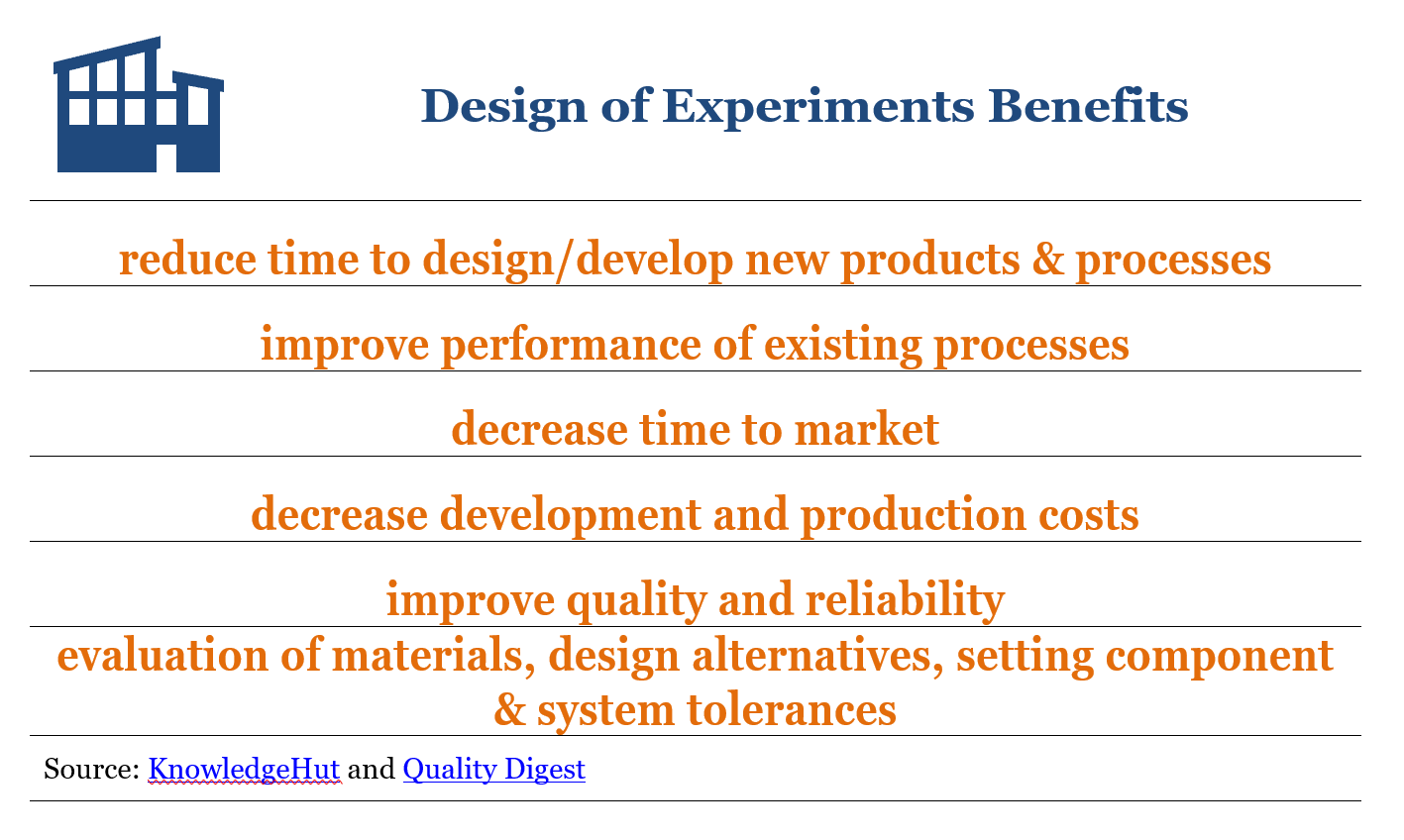
DOE is about creating an entity of experiments that work together to map an interesting experimental region. So with DOE we can prepare a set of experiments that are optimally placed to bring back as much information as possible about how the factors are influencing the responses. Another important application area for DOE is in making production more effective by identifying factors that can reduce material and energy consumption or minimize costs and waiting time. It is also valuable for robustness testing to ensure quality before releasing a product or system to the market. Get statistical thinking involved early when you are preparing to design an experiment!
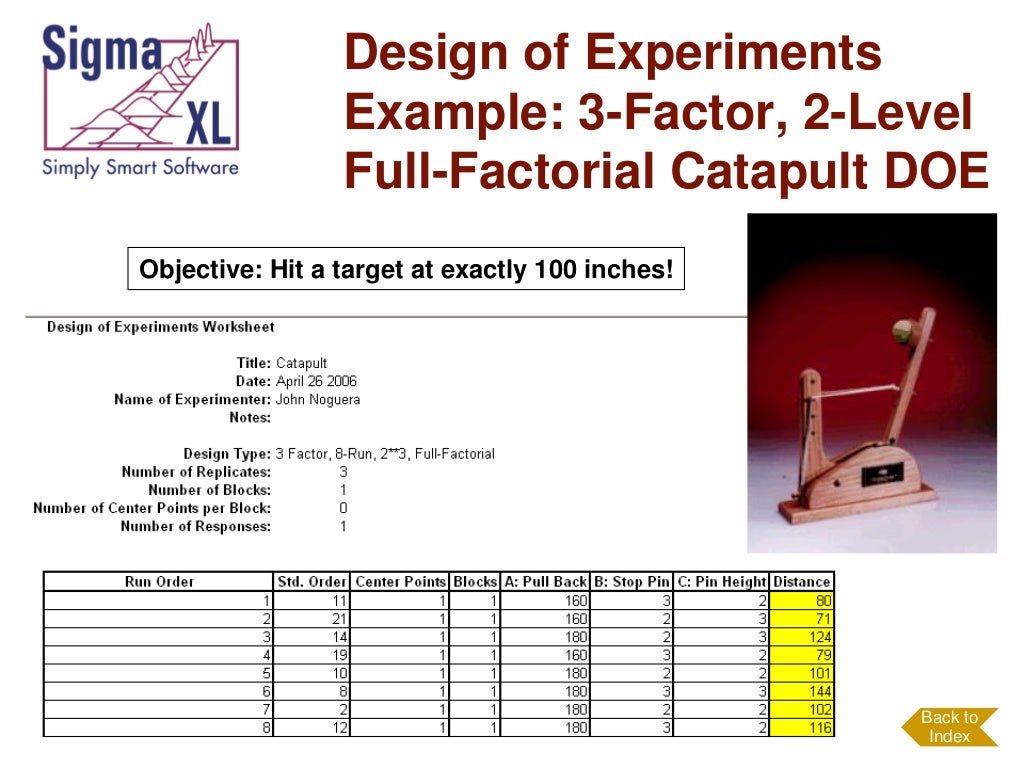
2 - The Basic Principles of DOE
After completing the experiment and collecting the data, the next step is to analyze the data and determine which input factors (X) or interactions (S) had the most impact on the process output (Y). By analyzing the data the experimenter can optimize the process by determining the combination of variables that produce the most desirable process output (Y). Computerized measures involve using software or computer programs to collect data on participants’ behavior or responses.
Purpose of Experimental Design
This optimization reduced material waste by 15% and increased production efficiency by reducing the instances of rework and testing required for quality assurance. Beauty in data visualization is the principle that recognizes the power of well-presented data to convey complex truths elegantly and effectively. It acknowledges that the clarity and aesthetics of data presentation can illuminate insights, making them accessible and impactful to a broader audience. How you apply your experimental treatments to your test subjects is crucial for obtaining valid and reliable results. Use arrows to show the possible relationships between variables and include signs to show the expected direction of the relationships.
learnstatisticseasily
In this article, let us discuss the definition and example of experimental design in detail. Goodness in methodology goes beyond the technical, embedding an ethical framework within which experiments are designed and conducted. It is a commitment to integrity, ensuring that the methods employed are both scientifically valid and morally sound, respecting the dignity of all participants and the sanctity of the natural world being studied. Confounding is something we typically want to avoid but when we are building complex experiments we sometimes can use confounding to our advantage. We will confound things we are not interested in order to have more efficient experiments for the things we are interested in.
Data Transformations for Normality: Essential Techniques
The article is one of a series that dives into various aspects of using generative AI as an instructor and course designer and is available on the Online Teaching website. McCurry details the process of drafting original prompts and then refining the results. Bohemian style is a great way to create a casual and eclectic look throughout your home. From decorating with patterns to incorporating natural materials, these decorating ideas will soon capture the laid-back charm of this style, in any room.
Types of Experimental Design
After you identify the process conditions and product components that affect product quality, you can direct improvement efforts to enhance a product's manufacturability, reliability, quality, and field performance. The term “Design of Experiments,” also known as experimental design, was coined by Ronald Fisher in the 1920s. He used it to describe a method of planning experiments to find the best combination of factors that affect the response or output. It is used to reduce design expenses because analysis of input parameters or factors gives way in identifying waste and which processes can be eliminated. It also helps remove complexities and streamlining the design process for cost management in the manufacturing process.
The scientific application of the statistical procedures became very important. Immediately following World War II the first industrial era marked another resurgence in the use of DOE. It was at this time that Box and Wilson (1951) wrote the key paper in response surface designs thinking of the output as a response function and trying to find the optimum conditions for this function.
Why Quality by Design (QbD) is vital for pharmaceutical R&D
Some variables, like temperature, can be objectively measured with scientific instruments. Others may need to be operationalised to turn them into measurable observations. In medical or social research, you might also use matched pairs within your between-subjects design to make sure that each treatment group contains the same variety of test subjects in the same proportions. First, you may need to decide how widely to vary your independent variable. You can also compare different levels for given factors, such as whether a cultivar from nursery A produces a higher yield, better taste, or both than a plant from nursery B.
A Design of Experiment (DOE) approach to correlate PLA-PCL electrospun fibers diameter and mechanical properties ... - ScienceDirect.com
A Design of Experiment (DOE) approach to correlate PLA-PCL electrospun fibers diameter and mechanical properties ....
Posted: Wed, 05 Jan 2022 20:53:48 GMT [source]
Blocking is a technique to include other factors in our experiment which contribute to undesirable variation. Much of the focus in this class will be to creatively use various blocking techniques to control sources of variation that will reduce error variance. For example, in human studies, the gender of the subjects is often an important factor.
Morphology and water flux of produced cellulose acetate membranes reinforced by the design of experiments (DOE) - ScienceDirect.com
Morphology and water flux of produced cellulose acetate membranes reinforced by the design of experiments (DOE).
Posted: Mon, 15 Feb 2021 08:00:00 GMT [source]
It involves carefully designing an experiment that can test the hypothesis, and controlling for other variables that may influence the results. With DoE, factors are identified, responses are interpreted, and waste is eliminated or changed. [This blog was a favorite last year, so we thought you'd like to see it again. ].Whether you work in engineering, R&D, or a science lab, understanding the basics of experimental design can help you achieve more statistically optimal results from your experiments or improve your output quality. Taguchi, a Japanese engineer, discovered and published a lot of the techniques that were later brought to the West, using an independent development of what he referred to as orthogonal arrays.
So what can be done to predict how a set of changes will likely affect the process output? In a factorial design, participants are randomly assigned to one of several groups, each of which receives a different combination of two or more independent variables. The importance of statistical quality control was taken to Japan in the 1950s by W Edward Deming.



No comments:
Post a Comment